
 Upload BOM

- Integrated Circuits (ICs)
-
Audio Special Purpose
Clock/Timing - Application Spec…
Clock/Timing - Clock Buffers, D…
Clock/Timing - Clock Generators…
Clock/Timing - Delay Lines
Clock/Timing - IC Batteries
Clock/Timing - Programmable Tim…
Clock/Timing - Real Time Clocks…
Data Acquisition - ADCs/DACs - …
Data Acquisition - Analog Front…
Data Acquisition - Analog to Di…
Data Acquisition - Digital Pote…
Data Acquisition - Digital to A…
Data Acquisition - Touch Screen…
Embedded - CPLDs (Complex Progr…
Embedded - DSP (Digital Signal …
Embedded - FPGAs (Field Program…
Embedded - FPGAs (Field Program…
Embedded - Microcontrollers
Embedded - Microcontrollers - A…
Embedded - Microprocessors
Embedded - PLDs (Programmable L…
Embedded - System On Chip (SoC)…
Interface - Analog Switches - S…
Interface - Analog Switches, Mu…
Interface - CODECs
Interface - Controllers
Interface - Direct Digital Synt…
Interface - Drivers, Receivers,…
Interface - Encoders, Decoders,…
- Discrete Semiconductor Pro…
-
Diodes - Bridge Rectifiers
Diodes - Rectifiers - Arrays
Diodes-Rectifiers-Single
Diodes - RF
Diodes - Variable Capacitance (…
Diodes - Zener - Arrays
Diodes - Zener - Single
Power Driver Modules
Thyristors - DIACs, SIDACs
Thyristors - SCRs
Thyristors - SCRs - Modules
Thyristors - TRIACs
Transistors - Bipolar (BJT) - A…
Transistors - Bipolar (BJT) - A…
Transistors - Bipolar (BJT) - R…
Transistors - Bipolar (BJT) - S…
Transistors - Bipolar (BJT) - S…
Transistors - FETs, MOSFETs - A…
Transistors - FETs, MOSFETs - R…
Transistors - FETs, MOSFETs - S…
Transistors - IGBTs - Arrays
Transistors - IGBTs - Modules
Transistors - IGBTs - Single
Transistors - JFETs
Transistors - Programmable Unij…
Transistors - Special Purpose
Diodes - Rectifiers - Single
- Isolators
- RF/IF and RFID
-
Attenuators
Balun
RF Accessories
RF Amplifiers
RF Demodulators
RF Detectors
RF Diplexers
RF Directional Coupler
RF Evaluation and Development K…
RF Front End (LNA + PA)
RF Misc ICs and Modules
RF Mixers
RF Modulators
RF Power Controller ICs
RF Power Dividers/Splitters
RF Receiver, Transmitter, and T…
RF Receivers
RF Shields
RF Switches
RF Transceiver ICs
RF Transceiver Modules
RF Transmitters
RFI and EMI - Contacts, Fingers…
RFI and EMI - Shielding and Abs…
RFID Accessories
RFID Antennas
RFID Evaluation and Development…
RFID Reader Modules
RFID Transponders, Tags
RFID, RF Access, Monitoring ICs…
- Sensors, Transducers
-
Accessories
Amplifiers
Capacitive Touch Sensors, Proxi…
Color Sensors
Current Transducers
Dust Sensors
Encoders
Float, Level Sensors
Flow Sensors
Force Sensors
Gas Sensors
Humidity, Moisture Sensors
Image Sensors, Camera
IrDA Transceiver Modules
Magnetic Sensors - Compass, Mag…
Magnetic Sensors - Linear, Comp…
Magnetic Sensors - Position, Pr…
Magnetic Sensors - Switches (So…
Magnets - Multi Purpose
Magnets - Sensor Matched
Motion Sensors - Accelerometers…
Motion Sensors - Gyroscopes
Motion Sensors - IMUs (Inertial…
Motion Sensors - Inclinometers
Motion Sensors - Optical
Motion Sensors - Tilt Switches
Motion Sensors - Vibration
Multifunction
Optical Sensors - Ambient Light…
Optical Sensors - Distance Meas…
More product categories >>
MEMS Sensors Working Principles, Functions, Types and Applications
1. What Is a MEMS Sensor?
MEMS Sensor (Micro-Electro-Mechanical Systems Sensor) is a miniature device that combines mechanical structures, sensors, actuators, and electronics on a single silicon substrate using microfabrication techniques.Unlike traditional sensors, MEMS sensors integrate microscale mechanical elements (such as beams, diaphragms, or proof masses) with electronic signal processing circuits, enabling high performance in an extremely compact form factor.
MEMS sensors are widely used to measure physical quantities, including motion, pressure, acceleration, rotation, sound, temperature, and magnetic fields.
2. Working Principle of MEMS Sensors
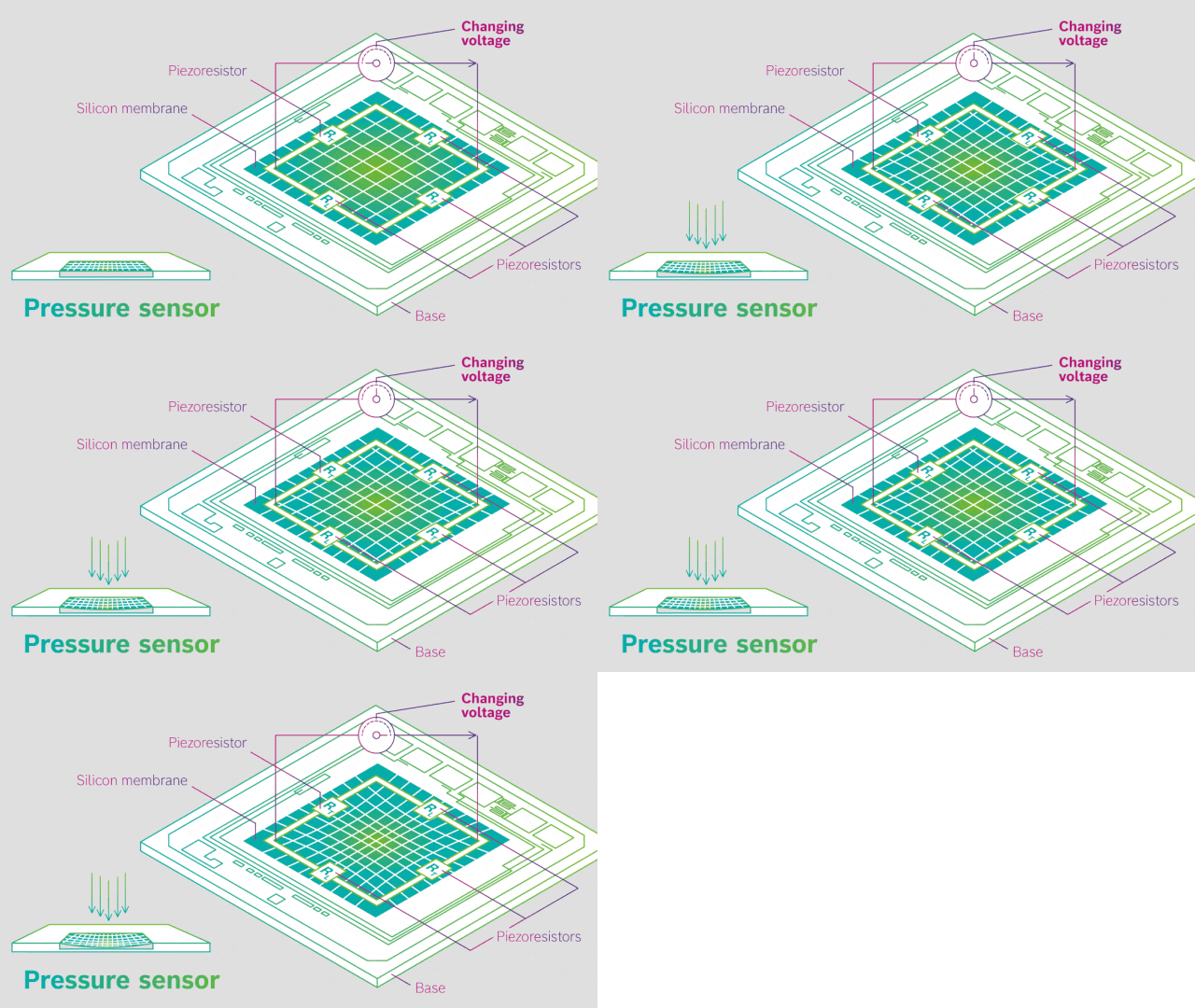
The working principle of MEMS sensors is based on the interaction between mechanical movement at the microscale and electrical signal conversion.General Operating Mechanism
- Physical stimulus (e.g., acceleration, pressure, rotation) acts on a micro-mechanical structure.
- The structure undergoes microscopic displacement, deformation, or vibration.
- This mechanical change is converted into an electrical signal using one of the following sensing methods:
- Capacitive
- Piezoelectric
- Piezoresistive
- Thermal
4. On-chip electronics amplify, filter, and digitize the signal for output to a microcontroller or processor.
Bosch MEMS sensors: Working principle of an accelerometer
Example: MEMS Accelerometer
- small proof mass is suspended by micro-springs.
- Acceleration causes displacement.
- The displacement changes capacitance between electrodes.
- The capacitance change is converted into a digital acceleration value.
3. Role and Purpose of MEMS Sensors
MEMS sensors serve as the interface between the physical world and digital systems. Their main roles include:- Detecting real-world physical parameters
- Enabling intelligent perception in electronic systems
- Providing real-time feedback for control systems
- Supporting automation, navigation, and monitoring
4. Core Functions of MEMS Sensors
MEMS sensors typically provide the following functions:- High-precision sensing at microscale
- Low power consumption for battery-powered devices
- Digital signal output (I²C, SPI, UART)
- Self-calibration and temperature compensation
- High integration with ASIC and DSP
- Fast response time and high sampling rates
5. Major MEMS Sensor Brands
The MEMS sensor market is dominated by several global leaders:| Brand | Strengths |
| Bosch Sensortec | Automotive-grade MEMS, high reliability |
| STMicroelectronics | Broad portfolio, industrial & consumer |
| TDK InvenSense | Motion sensors, IMU leadership |
| Analog Devices (ADI) | High-precision industrial MEMS |
| NXP Semiconductors | Automotive & industrial sensors |
| Murata | Gyroscopes, vibration sensors |
| Texas Instruments | Pressure and industrial MEMS |
| MEMSIC | Magnetic and motion sensors |
6. Common MEMS Sensor Models
Representative MEMS sensor models include:- MPU-6050 / MPU-6000: 6-axis IMU
- MPU-9250: 9-axis IMU
- BMI160 / BMI270: Low-power IMU
- LIS3DH: Accelerometer
- BME280: Temperature, humidity, pressure
- ADXL345: High-resolution accelerometer
- ICM-42688: Industrial-grade IMU
These models are widely used in commercial and industrial products.
7. Types of MEMS Sensors (All kind of Sensors)
Sensors Type
Details
Motion Sensors
Accelerometers
Gyroscopes
IMUs (Inertial Measurement Units)
Environmental Sensors
Pressure sensors
Temperature sensors
Humidity sensors
Gas sensors
Acoustic Sensors
MEMS microphones
Ultrasonic sensors
Magnetic Sensors
Magnetometers
Electronic compasses
Optical & Specialized Sensors
Micro-mirrors
LIDAR MEMS
Flow sensors
Vibration sensors
8. Applications of MEMS Sensors
- MEMS sensors are used across nearly all modern industries:
- Consumer electronics: smartphones, wearables, gaming
- Automotive: airbags, ADAS, navigation, tire pressure
- Industrial automation: vibration monitoring, robotics
- Medical devices: patient monitoring, surgical tools
- Aerospace & drones: flight stabilization, navigation
- Smart home & IoT: motion detection, environment sensing
Conclusion
MEMS sensors have fundamentally transformed how electronic systems perceive and interact with the physical world. Their miniaturization, integration, low power consumption, and scalability make them indispensable in modern technology.As applications in AI, autonomous systems, and IoT continue to expand, MEMS sensors will remain a core enabling technology driving innovation across industries.
MEMS Sensor Project Case
A. How MEMS Accelerometer Gyroscope Magnetometer Work & Arduino Tutorial

- Over 50,000 parts in stock

- One-stop shop

- Original parts at the competitive price

Copyright © 2025 Xinhou Future Technology Co., Limited




Subscription Results
If you do not receive it within 5 minutes, please check your spam folder or contact us via the website.